
liderado por Anonymous
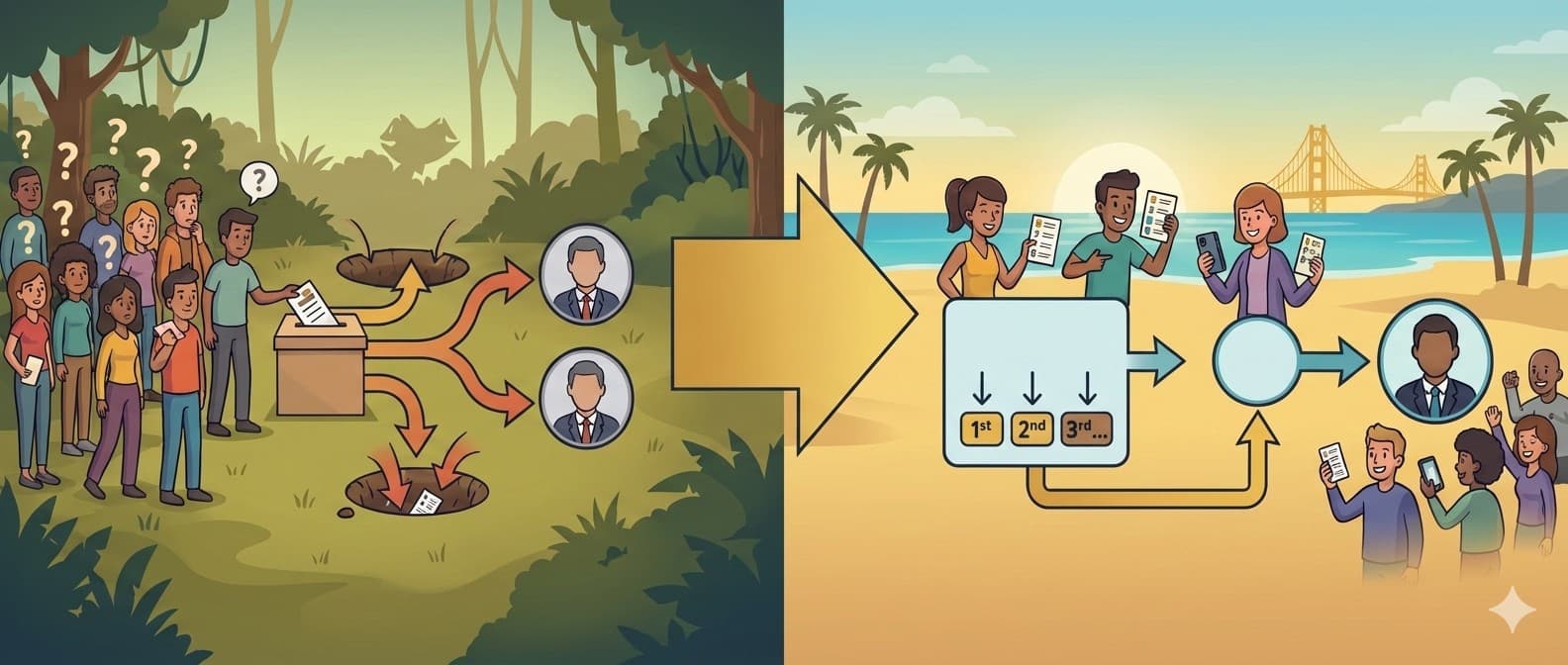
Tired of playing political games with your vote? Jungle primaries force you to pick the "lesser of two evils." With Ranked-Choice Voting, just rank your choices. Vote your heart and never waste a vote. Let's upgrade our elections and make this a reality!
Este grupo aún no ha agregado recomendaciones.
El mapa muestra a los miembros verificados y públicos del grupo.
Líder del grupo
Our democracy works best when elections actually reflect what voters want. But right now, our two-round "jungle primary" system frequently distorts the will of the people. It forces us to vote in low-turnout primaries that are highly vulnerable to "vote-splitting"—where similar candidates divide the majority vote and accidentally eliminate each other before the general election even happens.
This is a real, immediate threat. In the upcoming 2026 California governor's race, a crowded field threatens to severely fracture the vote. Statistical modeling estimates there is a 27% chance that vote-splitting in the primary will result in two minority-party candidates advancing, locking the state's dominant party out of the November election entirely. When a voting system can accidentally eliminate the majority's preferred choices through sheer math, it is fundamentally broken.
Ranked-Choice Voting is the upgrade we need. By ditching the primary and moving all candidates to a single, decisive election, we can eliminate vote-splitting, save taxpayer money, and guarantee that the ultimate winner actually has the support of the majority.
The Bottom Line:
Jungle Primaries force us to vote twice, risk locking out majority favorites, and frequently leave voters holding their noses to pick the "lesser of two evils" out of fear of wasting their vote.
Ranked-Choice Voting uses just one high-turnout election where you rank your choices. It prevents vote-splitting, eliminates the need to vote strategically, and guarantees the winner has demonstrated mathematical majority support.
Instead of just picking one candidate and hoping for the best, ranked-choice voting lets you rank the candidates in order of preference (1st choice, 2nd choice, 3rd choice, etc.) on a single ballot.
Here is how the math works in your favor:
Vote Your Favorite: You mark your 1st choice.
Majority Rules: If any candidate earns more than 50% of the first-choice votes, the election is over and they win.
The Instant Runoff: If no one hits 50%, an automatic "instant runoff" triggers. The candidate in last place is eliminated.
Your Backup Plan: If your 1st choice is the one eliminated, your vote isn't wasted. It instantly transfers to your 2nd choice. This counting process repeats until one candidate crosses the 50% finish line.
The End of Strategic Voting:
Because of this backup system, you no longer have to play political games or guess who is the most "electable." In our current system, people often abandon their favorite candidate because they are afraid of "throwing their vote away" or accidentally helping their least favorite candidate win. With ranked-choice voting, you can safely vote your conscience. If your true favorite doesn't have enough support to win, your vote simply transfers to your safe second choice.
For those who want to look under the hood, here is the breakdown of why a single-election ranked-choice voting system solves the mathematical and representative flaws of the traditional top-two jungle primary.
In a jungle primary, all candidates run on a single ballot, and only the top two vote-getters advance to the general election. Having this two-step process creates significant structural problems:
The "Vote-Splitting" Lockout: If a district is 60% Party A and 40% Party B, you would expect Party A to win. However, if Party A runs eight candidates and Party B runs only two, Party A's 60% is fractured. Party B's two candidates can easily capture the top two spots. The 60% majority is completely locked out of the general election by pure mathematical accident.
Low Turnout Decides the Choices: Primaries consistently see drastically lower voter turnout than general elections. This means a smaller, often more partisan fraction of the electorate decides who the final two options will be for the rest of the voters in November.
A Depressing General Election: Because only two candidates survive the primary, the general election—when voter turnout is at its highest—often features two candidates from the exact same party, or two extreme candidates. It leaves many voters with no voice in the most important election of the year.
Ranked-choice voting fixes these mathematical flaws by combining the primary and general into one, decisive election.
One High-Turnout Election: There is no primary. All qualifying candidates appear on the ballot in the main election, ensuring voters always have a full, diverse spectrum of choices when voter turnout is highest.
No More "Spoilers" or Lesser-of-Two-Evils: The spoiler effect is mathematically eliminated. Independent and third-party candidates can run without ruining the chances of mainstream candidates with similar platforms, and voters can support them without regret.
Saves Time and Taxpayer Money: Running two separate statewide elections is incredibly expensive. Consolidating the process into a single, decisive ranked-choice election saves millions of taxpayer dollars and reduces voter fatigue.
Incentivizes Positive Campaigning: In a traditional race, candidates win by tearing down their opponents. In a ranked-choice system, a candidate needs to be the second choice of their opponents' supporters. Candidates who run toxic, purely negative campaigns rarely win under this system.
Mandates Broad Appeal: To win, a candidate must build a consensus. They cannot rely solely on a passionate, extreme base to slip through a crowded plurality; they must actually appeal to the broad majority of the district.
FairVote (Ranked Choice Voting basics & data): https://fairvote.org/
Ranked Choice Voting Resource Center: https://www.rcvresources.org/
National Conference of State Legislatures (NCSL - Ranked-Choice Voting): https://www.ncsl.org/elections-and-campaigns/ranked-choice-voting

Sin anuncios, sin venta de datos, sin agenda política.
Cada votante se verifica con los padrones oficiales del estado.
Tu voto se suma al de miles de personas. Eso es lo que mueve las elecciones.